
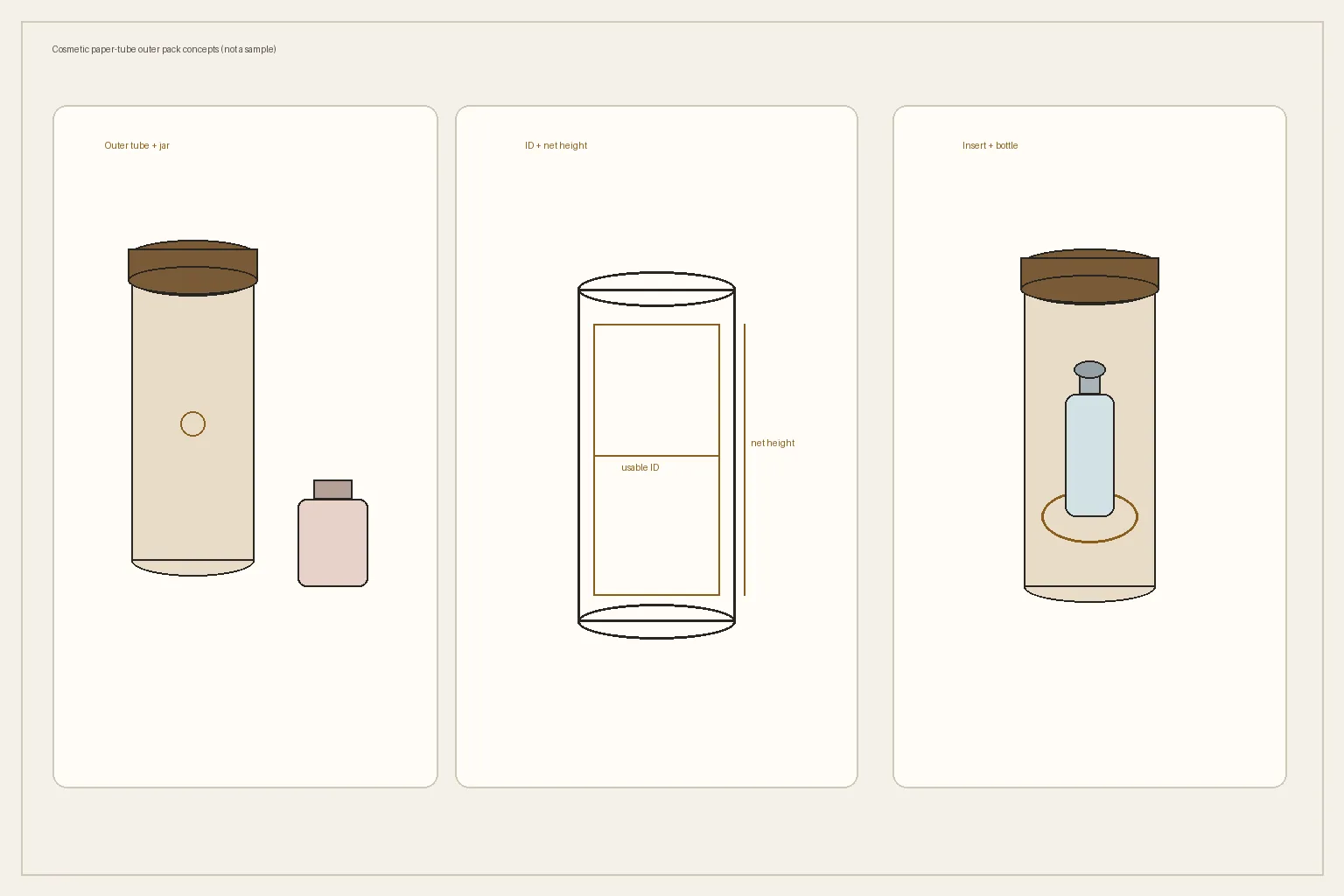
Paper tube outer pack vs soft squeeze tube
| Buyer means | What it is | This guide |
|---|---|---|
| Paper / cardboard tube, cylinder box, round gift tube | Secondary or outer pack around a sealed bottle, jar, vial or kit | Yes — ID, height, lid, insert |
| Soft tube, squeeze tube, lotion tube | Primary pack that holds the formula | No — out of scope |
State which type you need in the first line of the brief so quotes stay comparable. Review tube formats on our paper tube category.
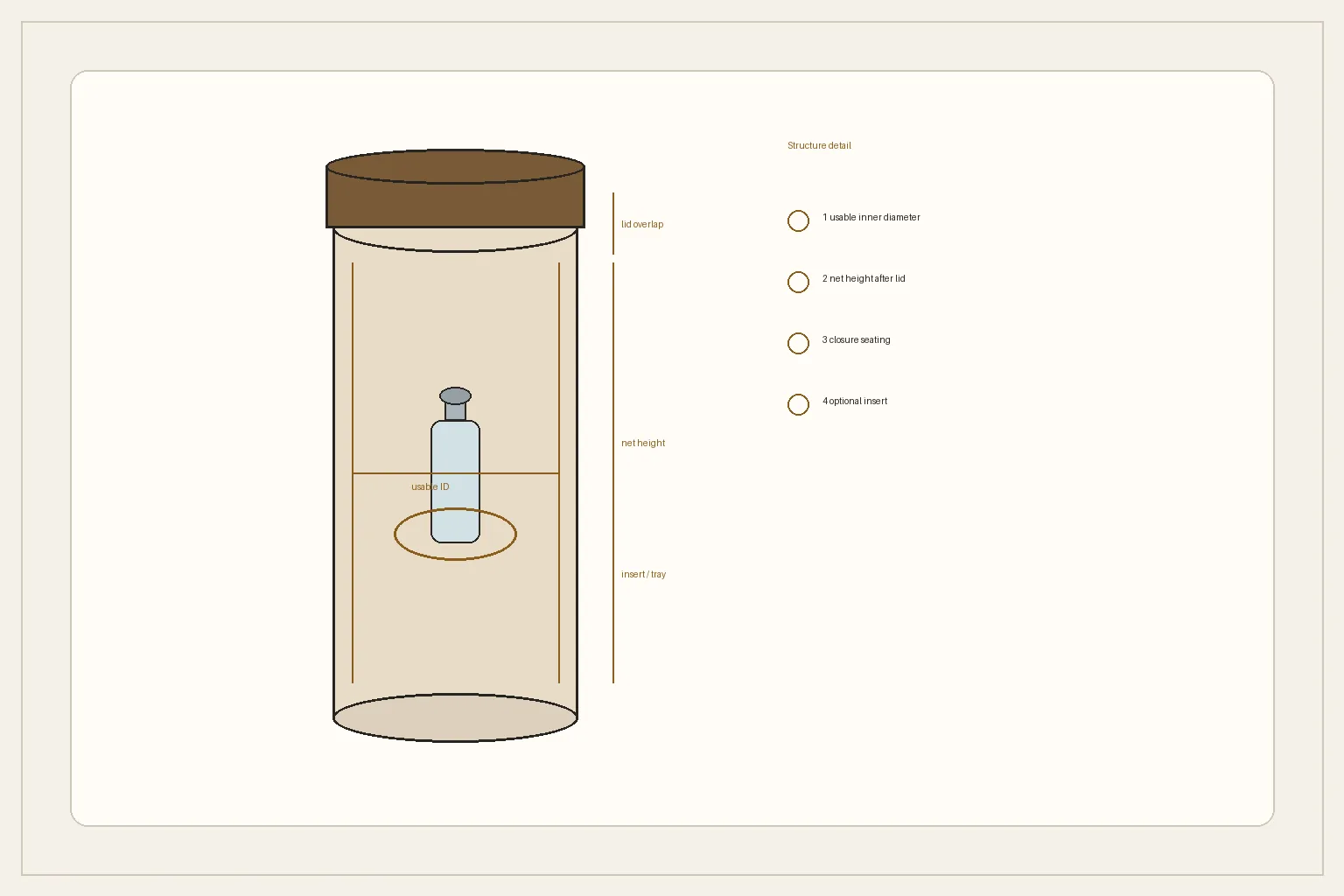
Confirm usable inner diameter
Measure the finished bottle or jar you will pack — including label thickness, pump, collar and any shrink band.
- Record the largest outer diameter across the body, label and any protruding shoulder.
- Ask for the proposed usable inside diameter after wrap, liner and board caliper — not only the outside diameter of the tube.
- A cap or pump wider than the body must still pass through the opening, or the pack must load from a different end — say which path you intend.
- Agree clearance on a sample with the real labelled product. Do not prescribe an unsupported standard gap.
Confirm net height after the lid
- Measure overall capped product height and packed weight.
- Ask for net / usable inside height after lid overlap, shoulder and base.
- State load orientation and whether the product is removed by body or by pump/cap.
- If several SKUs share one outer tube, size to the tallest and widest finished unit, or plan separate designs.
For a broader when-to-use decision, see the paper tube packaging buying guide. Wrap and print choices are covered in the kraft wrap, print and finish guide.
Closure: lid style and seating
Common cosmetic outer-tube closures include friction lids, telescoping lids and separate end caps. In the RFQ, name the closure type you want to quote, or ask the supplier to propose one and mark it as a proposal. Ask how the lid seats and how much height the overlap consumes. Note whether the closed pack must hide the bottle neck or leave label text visible. Review lid-to-body colour and finish on the assembled sample — flat proofs do not prove the closed look.
Insert, tray or end supports
Not every cosmetic tube needs an insert. Decide the function first.
| Need | Approach to discuss | What to send |
|---|---|---|
| Stop rattle of a narrow bottle in a wider tube | Collar, ring or paperboard supports | Bottle OD, tube ID target, how the unit is lifted out |
| Hold a jar off the base or centre it | Tray, platform or cupped support | Jar OD/height; confirm on a sample |
| Present a kit (bottle + vial + card) | Partition or nested tray | Part list, stacked heights, load order |
| No locator needed | Empty tube | Say so explicitly so quotes stay comparable |
Common mistakes
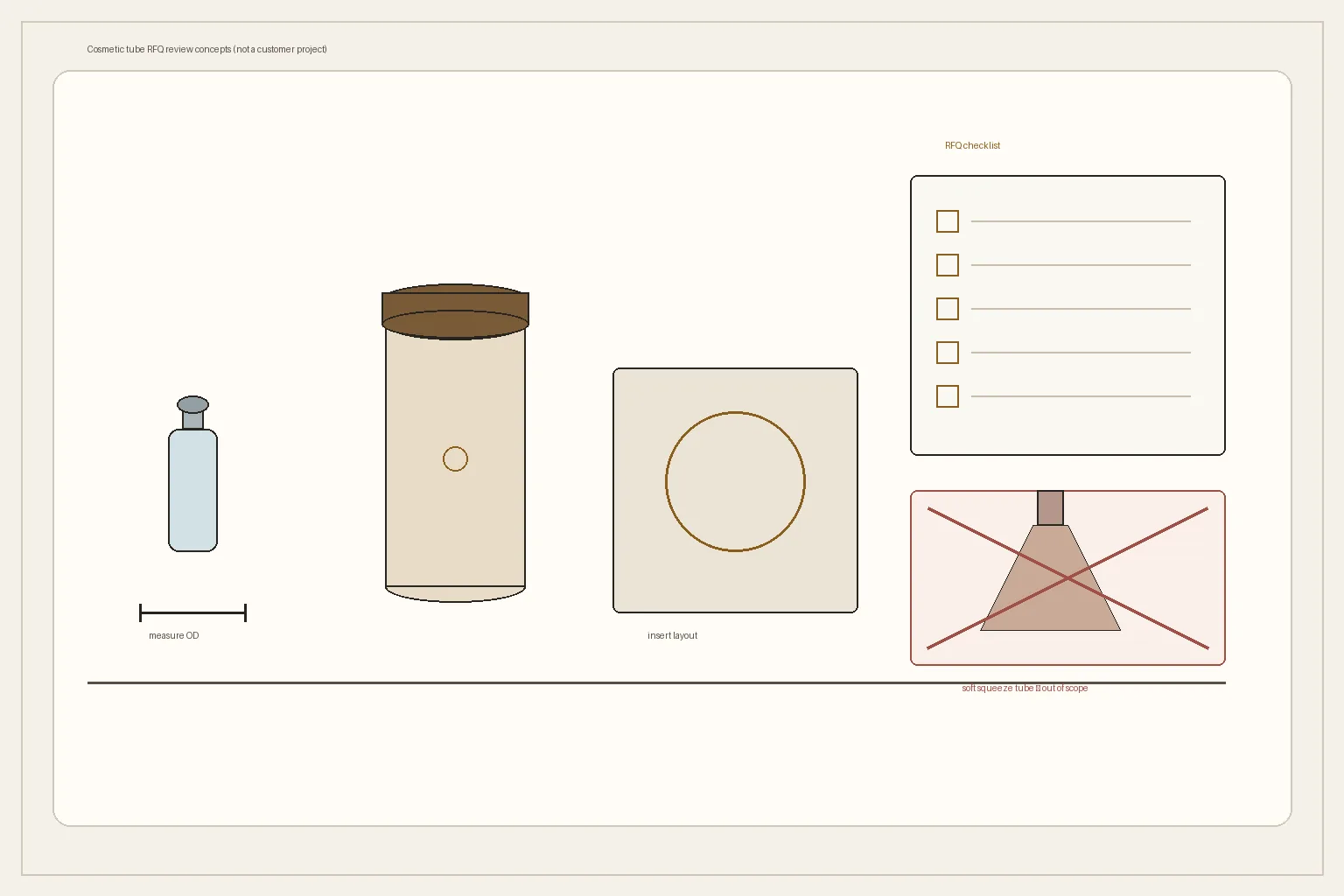
- Briefing a soft squeeze tube factory with cardboard-tube dimensions (or the reverse).
- Quoting outside diameter only and finding the labelled bottle will not enter the usable ID.
- Ignoring lid overlap so net height is short on the sample.
- Approving wrap artwork before a closed sample shows lid seating and visible text.
- Skipping insert function when the bottle rattles in the presentation pack.
- Combining two sizes into one MOQ line when each size is a separate design.
Buyer checklist for a quote
| Field | What to send | Why it matters |
|---|---|---|
| Pack type | Paper tube outer pack (not soft squeeze tube) | Keeps every quote on the same product |
| Product | Sealed bottle/jar/vial; SKU list | Defines secondary-pack scope |
| Outer diameter | Largest finished OD including label/pump | Sets usable ID discussion |
| Height | Capped height; request net / usable height | Sets lid and base stack-up |
| Closure | Lid style preference or “supplier propose” | Aligns construction |
| Insert | Function first; then sketch if any | Avoids empty vs supported mismatch |
| Artwork | Approved text/version per market; reserved code area | Separates wrap from lid zone |
| Quantity | Pieces per design / SKU | MOQ is per design |
| Market | Destination markets; required on-pack text | Labelling space |
MOQ, sampling and lead time
For planning against MUGE defaults (always subject to the formal quote): MOQ is 500 pieces per design — new artwork or a new size is a new design, and designs cannot be combined to meet MOQ. Sampling is typically 3–7 working days and bulk is typically 12–25 working days, both subject to quote. Die-cut and plate cost is included in the unit price. Fixed unit prices, discounts and payment terms are not published here.
MUGE PACKAGING has made custom packaging since 2014. FSC-certified paper available via a certified supplier. ISO 9001:2015 certificate 42724Q01532R0S covers production of packaging products within its stated scope; it is not a food-contact or product-safety certificate.
What to check on the first sample
Load the real sealed, labelled product. Confirm entry path, usable inner diameter, net height, lid close without crushing the pump, insert location, and that required text remains readable with the lid on. Record sample ID with the artwork version.
Frequently asked questions
- Is a paper tube the same as a cosmetic squeeze tube?
- No. A paper tube here is a cardboard outer cylinder around a sealed bottle or jar. A squeeze tube is a soft primary pack for the formula. Brief them as different products.
- Do I always need an insert inside the paper tube?
- No. Use an insert when you need to locate, cushion or present parts. If the bottle fits the usable inner diameter cleanly, an empty tube can be enough — say so in the RFQ so quotes stay comparable.
Send your cosmetic tube dimensions for review
Send finished bottle or jar measurements, lid preference, insert function, artwork version, quantity per design and destination market through the quote calculator or contact. We will separate confirmed inputs from proposed construction and items that need a sample before bulk. You can also compare structures on our paper tube category.