
The core rule
Measure the packed components before drawing partition cells
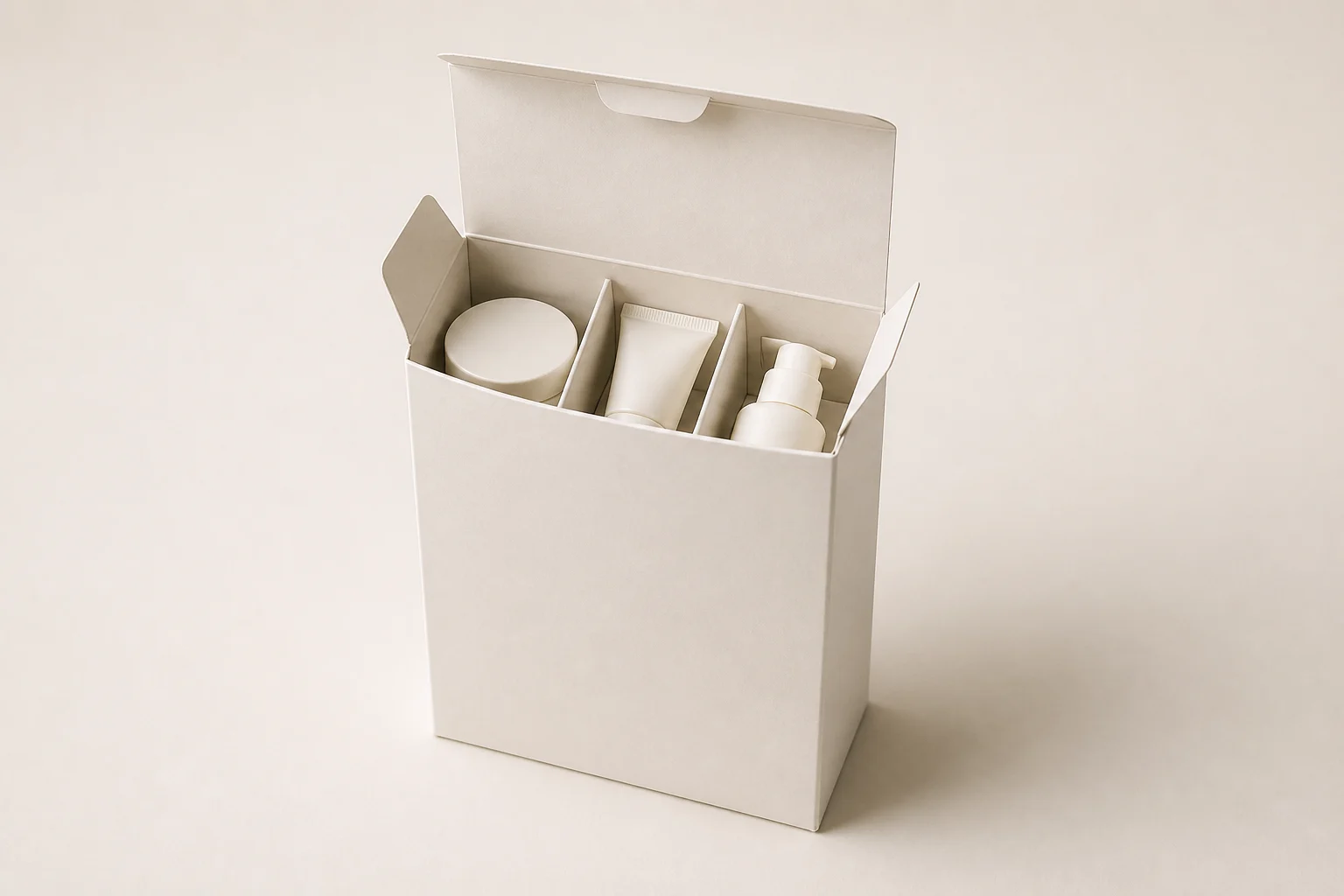
Container labels, shoulders, caps and pumps can be wider or taller than the nominal fill size suggests. Record the maximum packed dimensions and intended orientation for every component. Then map the cell order, contact points, divider height and removal path. The approved fit remains a sampling decision.
Six fields for a comparable RFQ
Packed components
List every container, cap, pump or accessory with maximum length, width, height, weight and orientation.
Cell map
Number each component position and state the cell length, width, divider direction and intended loading sequence.
Depth and access
Define divider height, product exposure, finger access, removal direction and acceptable movement.
Carton and board
State internal or external finished size, closure, board grade, grammage, caliper and grain direction.
Print and finish
Provide artwork status, colour reference and the exact panel for lamination, foil, UV or embossing.
Packing and sample
State delivery form, inner/master packing, quantity direction, destination and measurable sample checks.
Fit language
Replace “snug fit” with reviewable criteria
State where clearance is permitted, how much movement is acceptable, how the packer loads the components and how the buyer removes them. Divider depth affects separation and access, but it does not by itself prove protection. Any drop, vibration, compression or distribution requirement needs a separately defined test and acceptance plan.
Common specification gaps
- Using nominal jar capacity instead of measuring the finished packed container
- Giving only the outer carton size while leaving every partition cell undefined
- Calling the fit ‘tight’ without clearance, removal and movement criteria
- Naming paperboard by grammage alone without grade, caliper or structure review
- Requesting foil or spot UV without marking the target panel on the artwork
- Treating a visual sample as proof of transport or protective performance
Next step
Use the product page as the shared visual brief
Review the custom cosmetic paper box with partition insert, then send the measured component list, cell map, carton structure, board direction, artwork and sample checks. For wider structure choices, visit custom cosmetic packaging and the cosmetics packaging industry page.
Send the RFQ fields