
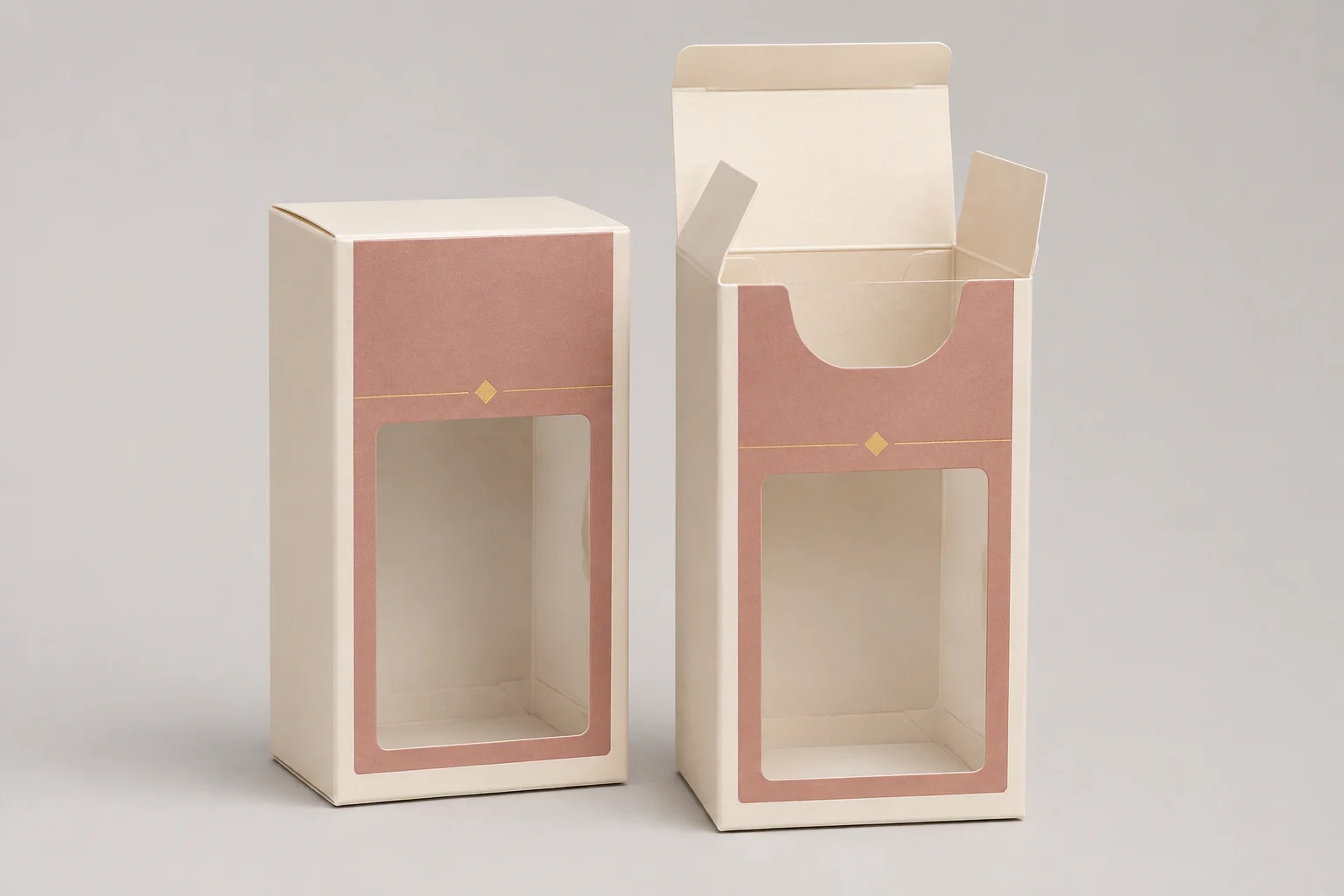
Start with the product, not the window shape
A display window does not establish packed-product fit. First record the finished product envelope and loading orientation. Then map the viewing panel around folds, glue areas and the desired visible feature. The final board grade, patch, clearance and pack performance need project review and sampling.
Choose the visible feature before the aperture
For a serum bottle, a buyer may want to reveal the bottle colour, cap or a particular label area. Mark that feature on a front-view product photograph at the intended packing orientation. A window that frames the bottle body is a different brief from one that exposes the full silhouette. Ask for both concepts on the same product outline before comparing quotes.
If the label is the display priority, ask what happens when the bottle turns or sits lower in the carton. A wider window cannot by itself fix rotation. Review product location and any separately specified paperboard insert; do not assume the clear patch holds the bottle in place.
Trade viewing area against the remaining panel
Draw three separate boundaries: the visible die-cut opening, the proposed patch footprint behind it, and the printed panel. Mark the nearest scores, carton seam and closure areas. Ask the supplier to return a marked-up drawing showing where the patch can be attached and which areas remain available for print. No universal edge distance or glue allowance is asserted here.
Compare a smaller feature window with a larger body window using the same carton size and product position. If the larger version crowds a fold, an artwork panel or the requested attachment area, revise the opening before approving decoration. Clear-film reflections can also change label visibility; check the proposed sample from the intended shelf angle instead of judging a flat artwork file alone.
Six fields for a comparable RFQ
Product envelope
Measure the finished product at its widest, deepest and tallest points, including cap, label and any accessory.
Viewing objective
State which product feature the window should reveal and which display side will face the buyer or retail shelf.
Window placement
Mark the window boundary against panel folds, tuck flaps, glue areas and the usable product position.
Patch direction
Describe the transparent patch as a proposed material and ask the supplier to review its placement, overlap and visible edges.
Artwork and finish
Provide print files, colour references, foil or UV locations and the window keep-clear area in the same brief.
Sample checks
Confirm the final product position, window alignment, opening, appearance and packing by sample; a concept image is not proof.
Avoid common window-brief gaps
- Choosing a window from a flat artwork view without showing the product orientation
- Letting the cut line cross an intended fold, closure or glue area
- Calling a transparent patch protective without a project-specific test plan
- Using a cosmetic concept image as proof of production fit or regulatory compliance
Return a window-specific sample decision
Photograph the packed sample from the agreed display side with the product seated as intended. Record whether the chosen feature stays within the aperture, whether unwanted edges or glue are visible, whether loading and opening disturb the patch, and whether the requested label space remains readable. Record observations, the drawing revision and the requested correction beside each photograph. Approval of appearance does not establish transit protection or material compliance.
Product and material reference boundary
MUGE PACKAGING's white-card material information identifies a paperboard direction for review. The cosmetic category linked below describes broader packaging options. These are first-party product descriptions, not independent testing or proof that this window concept has been manufactured. Final board, patch material, adhesive arrangement and fit require sampling.
Send the product page with your RFQ
Use the custom cosmetic folding carton with window patch as a shared direction, then send product dimensions, display side, artwork status, quantity, product weight and destination market. For broader category choices, see cosmetic packaging.
Send the RFQ fields