
Short answer
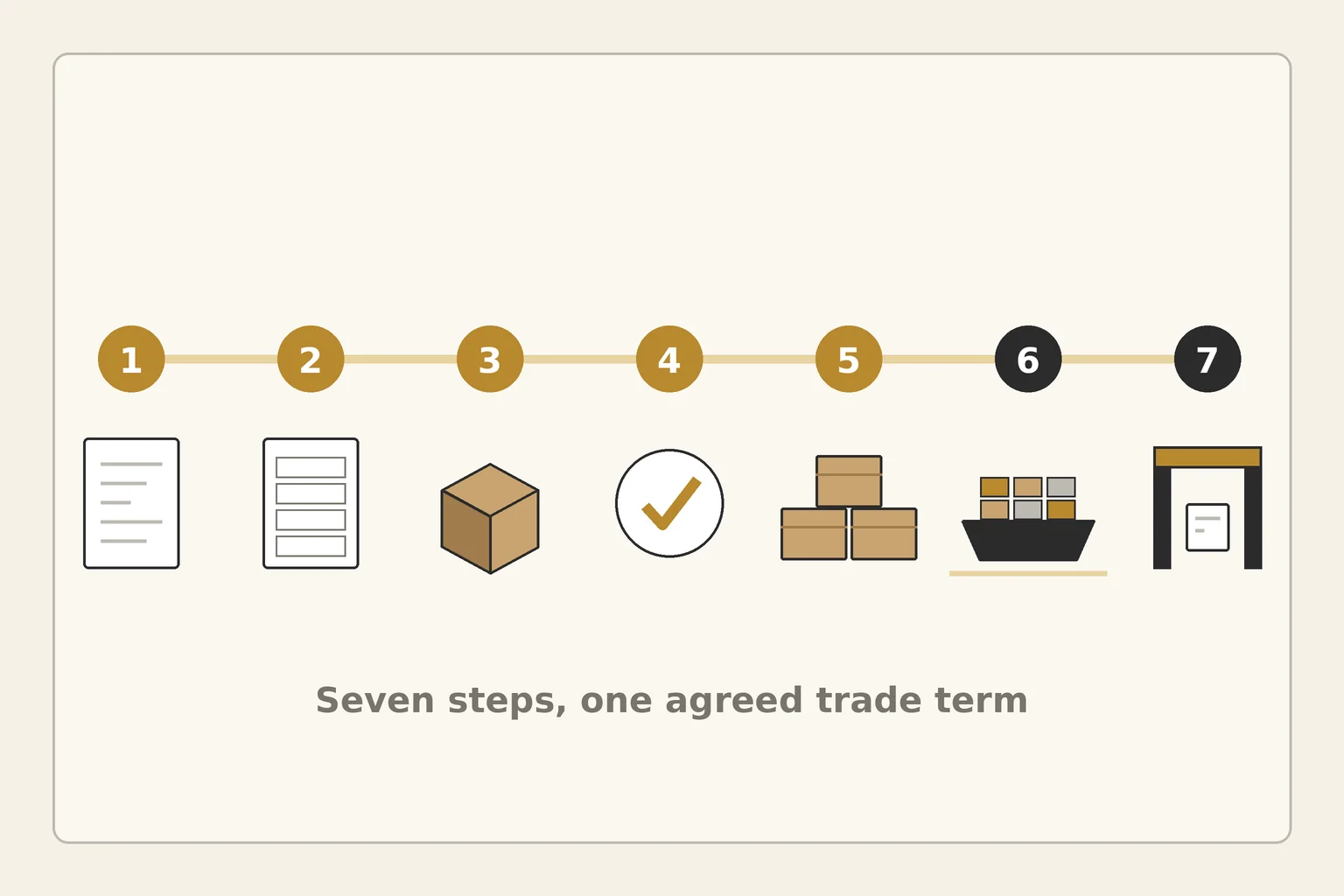
Importing custom packaging from China follows seven steps: brief, itemised quote, physical sample, approval, production, export packing and freight, then customs clearance. Your trade term decides who handles which step. A factory minimum, usually per design, sets the smallest first order, so check it before comparing prices.
The seven steps from brief to delivery
The sequence is the same whichever market you ship to. What changes is who does each step, and that is set by the trade term in your contract.
- Brief. Send the product type (folding carton, rigid gift box, paper tube, PVC/PET box or corrugated box), the inner size of the product it must hold, the quantity per design, the artwork status and your destination country. Naming the destination early matters, because it affects the trade term and the documents.
- Itemised quote. Ask for lines, not one figure: the unit price and what it includes, the sample cost, export packing, and the freight option you want. At MUGE the die-cut tooling and plate cost is included in the unit price, so there is no separate tooling line to hunt for. Production and sampling dates are confirmed in the quote.
- Physical sample. Do not approve bulk from a render. At MUGE sampling typically takes 3–7 working days, subject to the quote. Check size, fit, colour and finish on the real sample with your real product.
- Approval. Approve the sample in writing, with the artwork version and dimensions. After this point a change of artwork or size is a new design with its own minimum quantity, so settle the details now.
- Production. Bulk production typically takes 12–25 working days, subject to the quote. Ask for the production period and the ready date separately from the freight time, so you can plan each part on its own.
- Export packing and freight. The goods are packed for export and the commercial invoice and packing list are prepared according to the confirmed order. Freight then runs under the agreed trade term. The shipping policy lists the freight options: international express, air freight, sea freight, a truck delivery agent, or your own forwarder.
- Customs clearance. In the destination country the importer, usually through a broker or forwarder, makes the customs declaration, pays any duty and import tax, and takes delivery. This is the step most first-time buyers have not planned for, so the section on customs below explains it by market.
See how we run a project on our process page, and read the shipping policy for terms, documents and freight options.
If you are still choosing a supplier, start with our guide to choosing a custom packaging manufacturer in China and come back here when you have a shortlist.
EXW, FOB or CIF: what the trade term changes
A trade term, also called an Incoterms rule, says who arranges and pays for each part of the journey and where the risk of loss passes from seller to buyer. MUGE’s published terms are EXW, FOB and CIF, and the one that applies is set in the contract.
The term does not move import clearance. In all three, the buyer clears the goods into the destination country and pays any duty and tax.
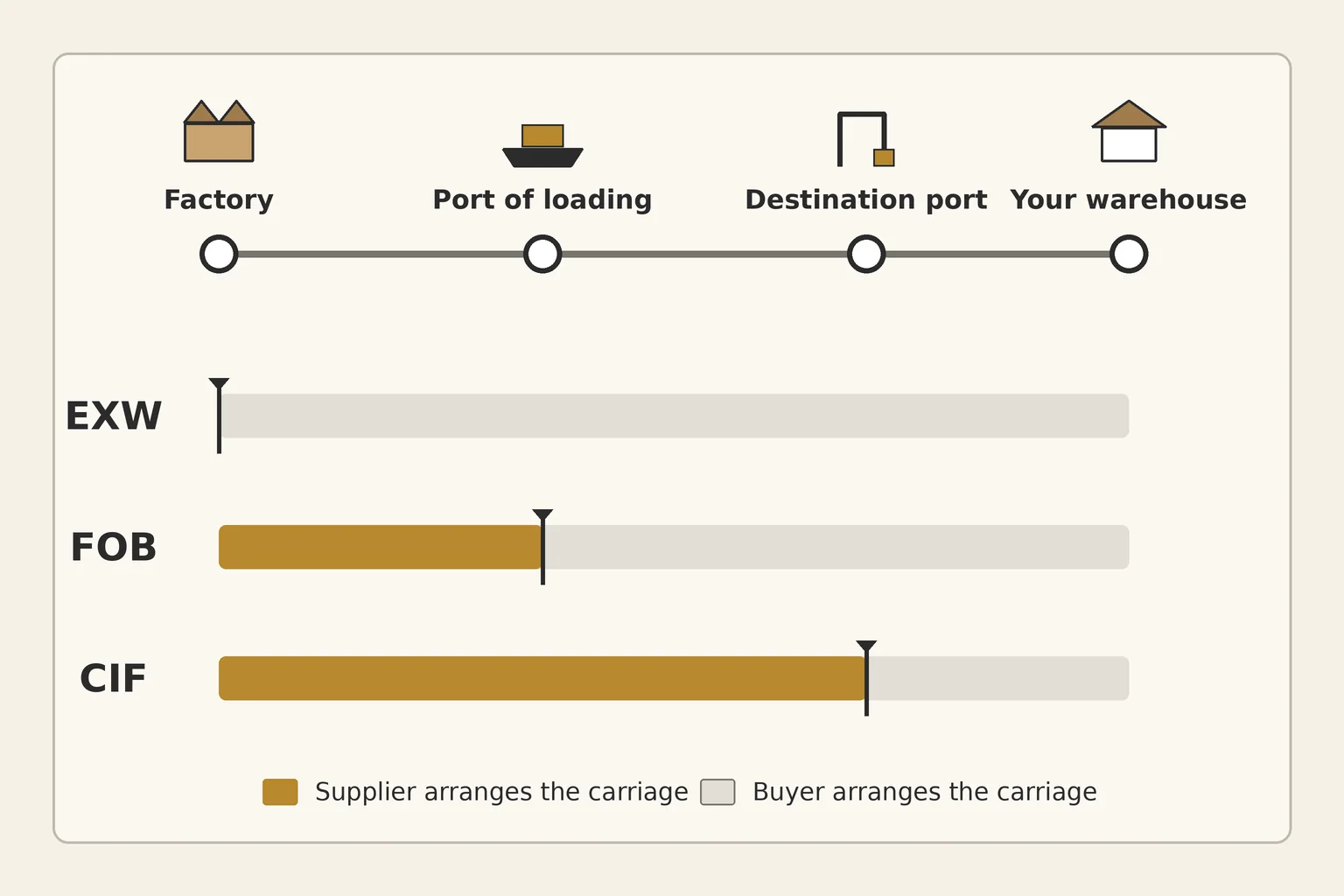
Who usually handles what under each trade term (Incoterms 2020; the contract decides)
| Step | EXW | FOB | CIF |
|---|---|---|---|
| Move the goods from the factory to the port of shipment | Buyer | Supplier | Supplier |
| Export clearance in China | Buyer* | Supplier | Supplier |
| Load onto the vessel | Buyer | Supplier | Supplier |
| Main sea freight | Buyer | Buyer | Supplier, to the named destination port |
| Cargo insurance | No obligation on either side | No obligation on either side | Supplier (minimum cover) |
| Destination port charges | Buyer | Buyer | Buyer, unless the supplier’s carriage contract covers them |
| Import clearance, duty and VAT | Buyer | Buyer | Buyer |
| Delivery from the port to your warehouse | Buyer | Buyer | Buyer |
* Under EXW the seller has no duty to clear the goods for export. Export clearance is often arranged by the supplier as the buyer’s agent, if that is agreed in the contract. FOB and CIF are sea-freight terms. Air and express shipments normally use other Incoterms rules, so confirm in your quote which term applies to your shipment. Under both FOB and CIF the risk passes to the buyer once the goods are on board at the port of shipment, even though under CIF the supplier pays the freight.
What to ask every supplier so quotes compare
Two quotes are only comparable if they cover the same lines. Send every supplier the same checklist and ask for the answers in writing.
- Unit price and what it includes. Ask what is inside the unit price: material, printing, finish, inserts if any. Quotes only compare when the specification is identical.
- Tooling. Ask whether die-cut tooling and plates are a separate line. At MUGE they are included in the unit price.
- Sample fees. Ask each supplier about sample fees and get the answer in writing before you order a sample.
- Export packing. Ask how the cartons are packed for export and whether that is already in the quote.
- Freight and insurance. Ask which trade term the quote assumes, which freight method it covers, and who arranges and pays for insurance.
- Customs. Ask who clears customs at destination and whether that is part of the quote. Under EXW, FOB and CIF it is normally the buyer.
- Duty and VAT. Ask the supplier to state that duty and VAT are excluded or included, so no line is assumed on either side.
- Documents. Ask which documents come with the shipment, and whether your broker needs anything else.
A low unit price can hide a separate tooling line or an unquoted freight line, so compare the whole list rather than one number. Our compare page helps you set quotes side by side, and the quote calculator gives a non-binding estimate while you shortlist.
Customs, duty and VAT: what the importer does
This section describes the process only. It does not state duty rates, thresholds or tariff codes, because they depend on your product, where it was made and the date of import, and they change. It is not legal or tax advice. Use the official pages linked in each part and ask your customs broker or forwarder to confirm the details for your shipment.
United Kingdom
- To import into England, Wales or Scotland you need an EORI number that starts with GB. Northern Ireland has different rules, so check them if that is your destination.
- Most businesses that import goods use a transporter or customs agent to make the declaration, though you can do it yourself.
- The import declaration needs a commodity code and the value of the goods. The code decides the rate of duty and whether a licence is needed.
- If you are VAT registered you may be able to claim back import VAT, and you must keep commercial invoices and customs paperwork as records.
Check the current rules at: Import goods into the UK: step by step (GOV.UK). Checked on 2026-11-03.
European Union
- Goods must be cleared by customs before they circulate in the single market. The carrier supplies advance safety and security information, called an entry summary declaration, before the goods arrive.
- A customs declaration is lodged online at the customs office where the goods are presented. It is usually made by the owner of the goods or by a representative acting for them, and as a rule these parties are established in the EU.
- An EORI number is needed for customs clearance, including import, and it is issued by the customs authority of an EU country.
- Any import duty and VAT are worked out from the nature, customs value and quantity of the goods, using the date the declaration is accepted.
Check the current rules at: Importation (EU Taxation and Customs Union); Customs declaration; EORI number. Checked on 2026-11-03.
United States
- CBP does not require an importer to hold a licence or permit, but other agencies may require one, depending on the commodity. Check the requirements for your product before you ship.
- CBP entry forms ask for an importer number. This is normally the business’s IRS registration number, or a number assigned by CBP.
- Goods are classified under the Harmonized Tariff Schedule, and the classification drives the duty. CBP suggests that new importers contact the port of entry and ask for an import specialist, describing the goods in detail.
- A customs broker can file the entry on your behalf. Questions about state or local sales tax are separate from CBP entry and belong with your tax adviser.
Check the current rules at: Basic Importing and Exporting (CBP); Tips for New Importers and Exporters (CBP). Checked on 2026-11-03.
Documents that travel with the goods
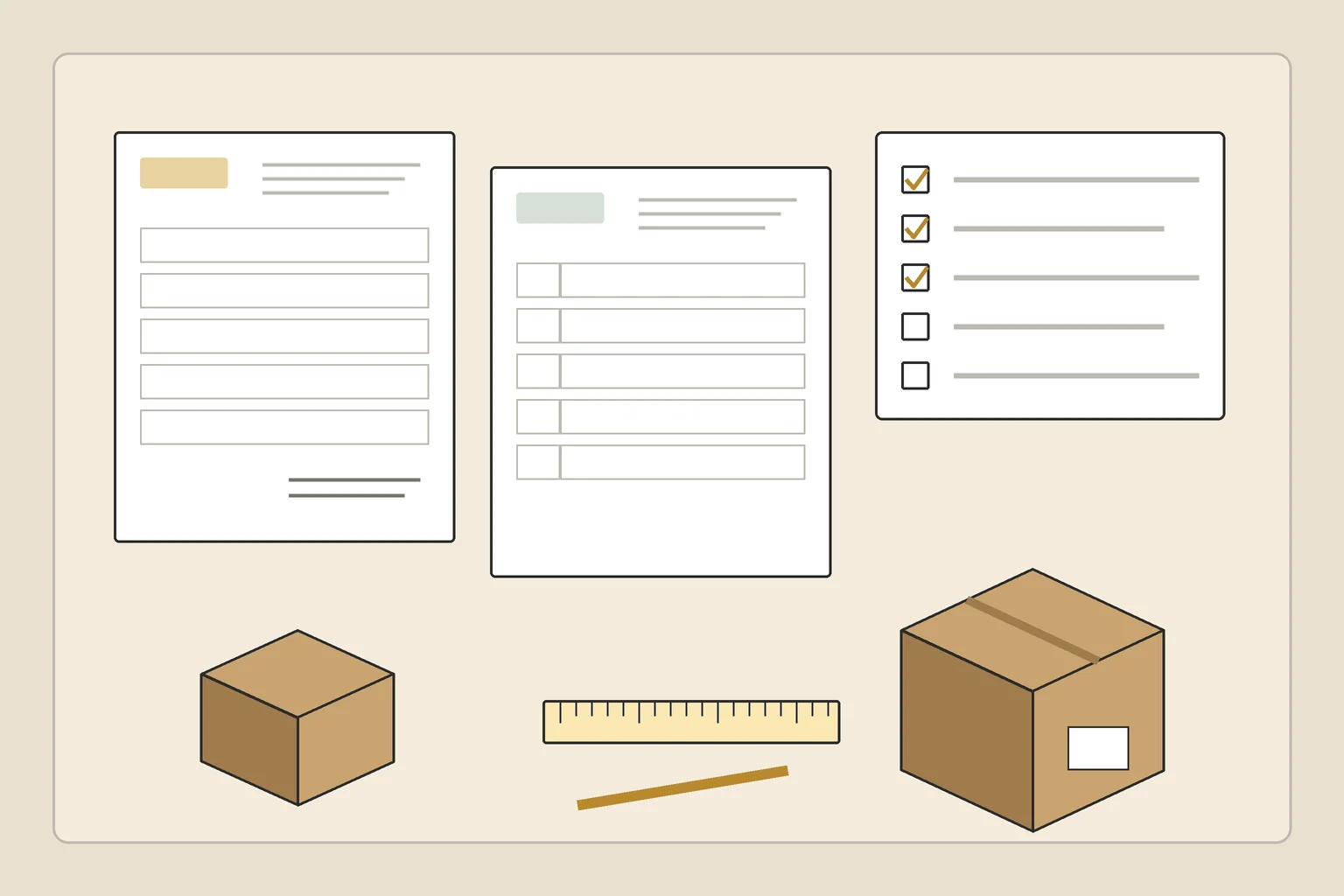
The standard export documents are the commercial invoice and the packing list, prepared according to the confirmed order. They are the base of the customs declaration, so the product description, quantities and values on them must match the order.
Your customs broker or forwarder may ask for more, depending on the destination and the product. Ask them early, and tell us before shipping, so the paperwork matches what they need.
Timeline you can plan around
Add the parts in order, and ask for each one separately. At MUGE the confirmed production figures are typical and subject to the quote. Freight depends on the method you choose, and customs clearance depends on your declaration and on any checks, so neither has a number here.
- Sample approval date.
- Plus bulk production: typically 12–25 working days, subject to the quote.
- Plus export packing and handover under your trade term.
- Plus freight: depends on air, sea or express, so ask your forwarder.
- Plus customs clearance in the destination country.
- Plus delivery from the port or airport to your warehouse.
Work backwards from the date you need the packaging on your shelf. Fix the sample approval date first, because every later step starts from it, and keep a buffer for freight and clearance rather than counting on the shortest case.
First-order reality check
MUGE PACKAGING is a manufacturer in Shenzhen since 2014. Its five product lines are folding cartons, rigid gift boxes, paper tubes, PVC/PET boxes and corrugated boxes. The minimum order is 500 pieces per design. A new artwork or a new size counts as a new design, each design must reach 500 on its own, and designs cannot be combined to make up the number. Read the details of the MOQ of 500 per design before you plan a range.
A physical sample is made first, so budget time for it. If you need fewer than 500 of a design, an online short-run printer may suit your first run better, and a factory order can follow once the design is proven. Import costs and paperwork are largely the same work whether the order is large or small, so a very small run carries a larger share of them per piece.
Frequently asked questions
- How do I import custom packaging from China?
- Send a brief and compare itemised quotes, approve a physical sample, then place the order. Production is followed by export packing, documents and freight under the agreed trade term. You or your broker then clear customs and pay any duty and tax. Each step and date is confirmed in writing.
- What is the difference between EXW, FOB and CIF?
- Under EXW you collect the goods at the factory; under FOB the supplier delivers them onto the ship at the named port and you pay the main freight; under CIF the supplier also pays freight and insurance to your destination port. In all three you normally clear import and pay duty. The contract decides.
- Who pays import duty and VAT or sales tax?
- The importer of record normally pays import duty and VAT or sales tax in the destination country, whichever trade term is used. Rates depend on the product classification and the origin and are set by the customs authority. Check the current rules with your customs broker or the official government guidance.
- How long does it take to get custom packaging from China?
- At MUGE, sampling typically takes 3–7 working days and bulk production typically 12–25 working days, confirmed in your quote. Freight time is on top and depends on air, sea or express and on customs clearance. Ask every supplier for production and delivery dates separately.
- What documents come with a shipment?
- Standard export documents include the commercial invoice and the packing list, prepared according to the confirmed order. Your freight forwarder or customs broker may ask for more, depending on the destination and the product. Tell us your broker’s requirements before shipping so the paperwork matches.
- What should I ask suppliers so I can compare total cost?
- Ask for identical quotes covering unit price, tooling, sample fees, export packing, freight, insurance, and who handles customs, duty and VAT. A low unit price can hide separate tooling or freight lines. At MUGE, die-cut tooling and plate fees are included in the unit price.
- Do I need a customs broker or freight forwarder?
- Most importers use one, because the broker or forwarder prepares the customs declaration and arranges freight and delivery. MUGE ships under EXW, FOB or CIF terms and can work with your own forwarder. Choose the setup before you approve the quote so the trade term matches.
- Can I import a small first order?
- The minimum is 500 per design, so a first order is at least 500 pieces of one design; a new artwork or size is a new design. A physical sample is made first. If you need fewer than 500 of a design, an online short-run printer may suit the first run better.
Send your brief and destination country
Send your brief and destination country; we quote EXW, FOB or CIF. Include the product type, size, quantity per design, artwork status and your forwarder if you have one, through the quote calculator or contact. The quote confirms the sample and production dates for your project.