
Packaging RFQ guide
Cosmetic Paper Sleeve RFQ Guide
To request a cosmetic paper sleeve with a folding carton, specify the product envelope, carton closure, sleeve coverage and visible panels separately. Add the proposed material, artwork revision, quantity and a physical sample question. A render or nominal container volume does not define the finished package envelope.
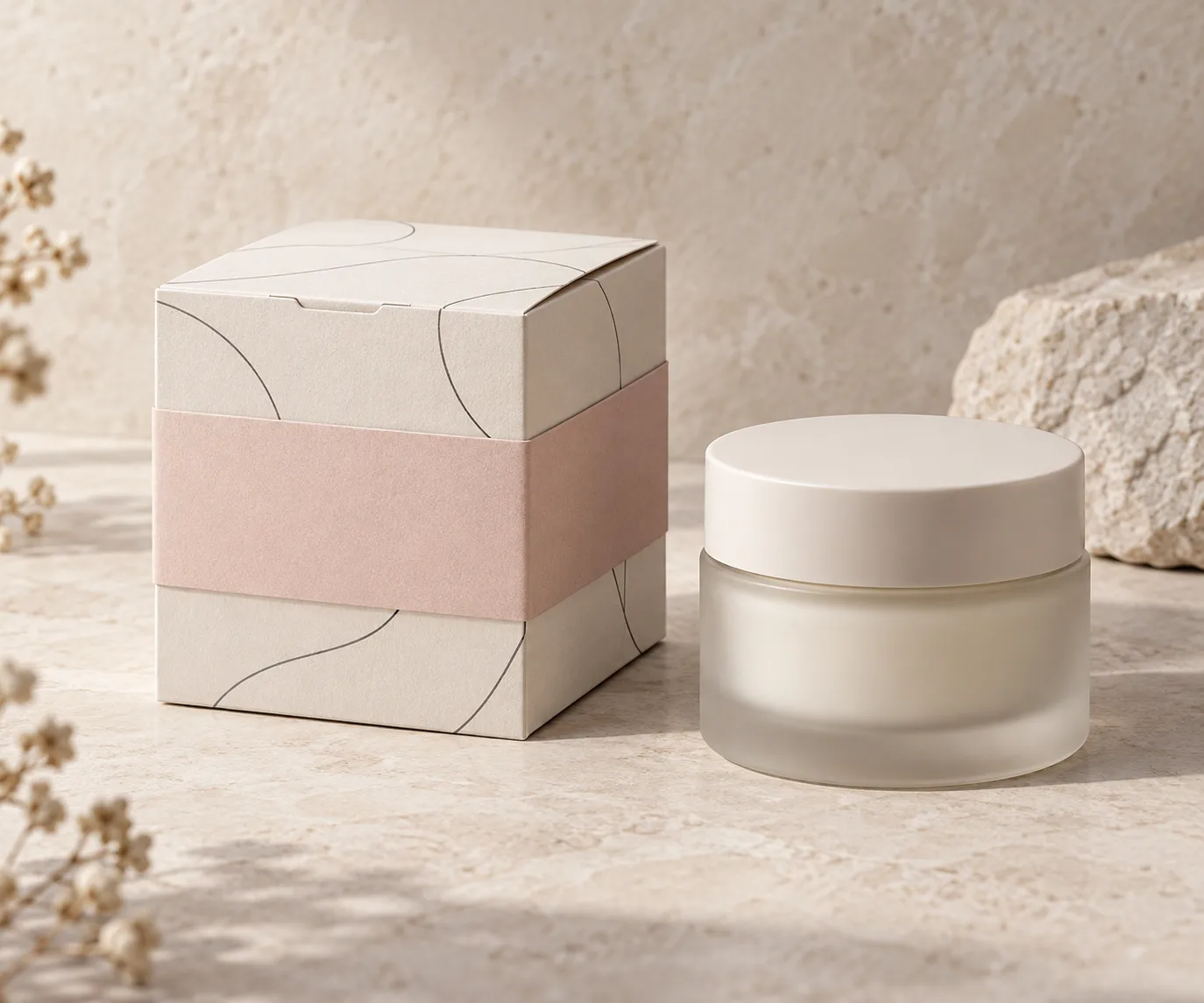
1. Record the finished product envelope
Provide maximum outside length, width and height, including caps, labels and any overhang, plus packed weight. State the loading orientation and which surfaces may contact the carton. If several SKUs share the artwork, list their envelopes separately; equal nominal volume does not establish equal outside dimensions. Ask for proposed usable carton space rather than assuming a clearance or board thickness.
2. Separate carton closure from sleeve coverage
Mark the carton opening direction, sleeve removal direction and panels that should remain visible. A narrow band, a longer wrap and a full-height sleeve are different proposals, not interchangeable specifications. State whether the sleeve arrives fitted or is added during packing. If the brief also needs an insert, record that as a separate support decision; a sleeve image does not demonstrate container retention.
Use an annotated front, side and opening view to show the intended overlap, seam and coverage. Ask the supplier to identify the proposed assembled dimensions. Do not derive a dieline from these concept images.
3. Mark artwork and material decisions on both parts
Send separate carton and sleeve artwork files with revision names. Mark the panels that must show the product name, barcode or other buyer-supplied text when assembled, as well as areas hidden by the sleeve. Compare printed alignment on the assembled package, not only on a flat proof. Ask the responsible brand team to confirm required labeling for the destination market; this guide is not a labeling or compliance assessment.
Record the proposed paperboard material and print or finish direction for each part. A shared color reference does not prove a match across different boards or finishes. Ask what the sample will demonstrate and what still needs confirmation before production.
4. Give the physical sample a decision to answer
Review the sample with the actual product and current artwork. Record loading and removal, carton closing, sleeve movement, seam position and whether intended text remains visible. Agree the acceptance criteria with the project team before approving anything. If a sleeve obscures a panel or drags during removal, record the observation and the revision to recheck; these are review scenarios, not claimed failures from a completed MUGE project.
The finished carton, sleeve and product fit require sampling. These concepts do not establish production tolerances, load performance, transport protection or testing. Any distribution or document requirement belongs in the project brief and needs its own evidence.
5. Send one RFQ with the unresolved choices visible
- Finished product length, width, height, packed weight and the orientation for loading
- Carton closure direction, insert needs and the sleeve coverage or visible-panel requirement
- Proposed board material, artwork files, print and finish direction, including areas that must remain exposed
- Quantity by SKU, destination market and the sample question to resolve
Label unknown inputs as “to review” instead of guessing a specification. Quantity by SKU, artwork variants, the destination market and whether the sleeve is supplied fitted help keep proposals comparable. Prices, timing and final construction remain subject to a project-specific review.
Review the custom cosmetic paper sleeve with carton, compare cosmetic packaging, and send your project inputs.
Source scope and project responsibility
MUGE’s official cosmetic packaging overview identifies folding cartons among the structures available for project review. The official materials directory provides material directions, not a confirmed specification for this sleeve. These first-party sources support service scope; they are not independent tests of the illustrated concepts.
Prepared by MUGE PACKAGING. Andy — Chief Designer & Project Manager is a project contact; no individual article review is claimed.